Minoxidil for Traction Alopecia: Helpful Tool or Overhyped Solution?
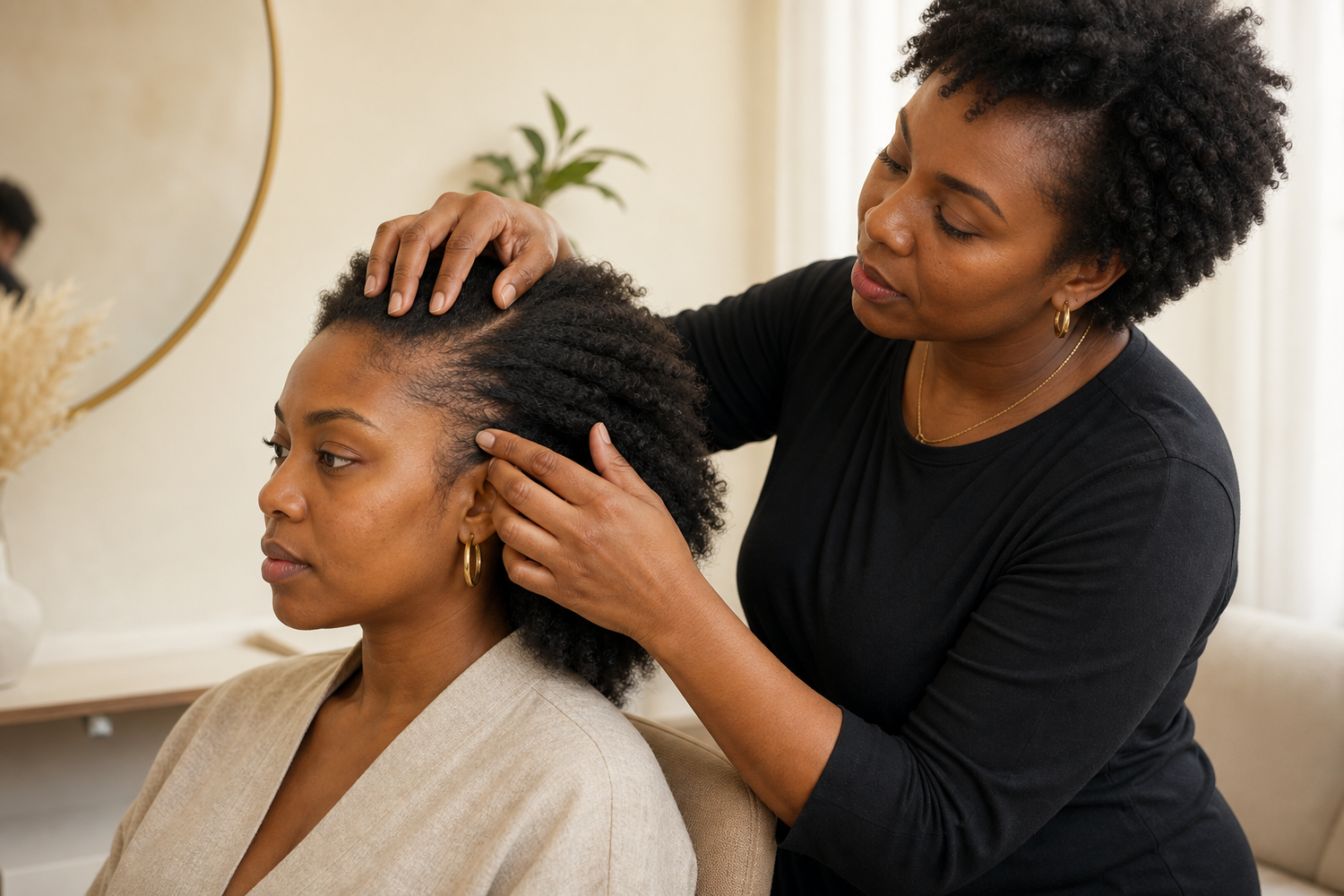
A growth product cannot outwork the tension that keeps injuring the follicle.
Minoxidil may support some viable follicles, but it cannot outwork the repeated tension that caused the injury.
You may have seen the before-and-after photos: a thinning hairline, a bottle of minoxidil, a few months of progress, and a caption that makes it sound as though the entire problem has been solved.
But traction alopecia is not simply a growth problem. It is an injury problem.
When tight styling, heavy extensions, painful installations, or constant manipulation continue to traumatize the follicles, adding a growth product without changing the styling habits is like watering a plant while someone continues pulling it from the soil.
Minoxidil may have a role in a broader treatment plan. The current research, however, is much weaker than social media often makes it appear—and removing the source of tension must remain the foundation of care.
First, What Is Traction Alopecia?
Traction alopecia is hair loss caused by prolonged or repeated pulling on the hair follicles. It often appears at the temples, edges, frontal hairline, behind the ears, nape, or crown, depending on where styling force is concentrated.
Early signs can include tenderness, redness, bumps, broken hairs, thinning edges, or small cylindrical hair casts around the strands. In early stages, follicles may remain intact and capable of healthy growth.
When tension continues for months or years, damage can progress to follicular miniaturization, fibrosis, and permanent scarring. A follicle replaced by scar tissue cannot simply be switched back on by a topical product.
Where Does Minoxidil Enter the Conversation?
Minoxidil is a medication that can support hair growth. Topical minoxidil is applied to the scalp, while low-dose oral minoxidil is prescribed and medically supervised.
It is best known for pattern hair loss and is believed to support follicles partly by prolonging the active growth phase of the hair cycle. That evidence does not automatically transfer to every other cause of thinning.
Traction alopecia begins with mechanical stress. The better question is not merely whether minoxidil can grow hair, but how strong the evidence is for traction alopecia and under what conditions it may help.
What the 2026 Systematic Review Found
A 2026 systematic review examined topical and oral minoxidil for traction alopecia. Researchers initially identified 85 results, but only six studies met the inclusion requirements. Some reports described improvement beginning at approximately three months.
Most of the available evidence came from case reports and retrospective case series rather than large randomized, controlled clinical trials. Those observations can identify promising possibilities, but they cannot reliably separate the effect of minoxidil from reduced tension, other treatments, natural recovery, or combined care.
Because the studies were limited and lacked strong objective data, the authors classified the evidence supporting minoxidil for traction alopecia as very weak. They described minoxidil as a possible adjunctive measure—not a stand-alone answer—and called for larger studies with objective regrowth measurements.
Weak Evidence Does Not Mean Zero Benefit
Weak or very weak evidence does not necessarily mean a treatment is useless. It means there is not enough high-quality research to make broad promises about who will respond, how much regrowth to expect, or how long results may last.
Individual reports describe improvement with topical or oral minoxidil, but one successful case cannot predict every outcome. Response may depend on how long traction has occurred, whether follicles remain intact, whether scarring or inflammation is present, whether tension has stopped, and whether the diagnosis is correct.
Hairline thinning can also overlap with alopecia areata, frontal fibrosing alopecia, central centrifugal cicatricial alopecia, pattern hair loss, breakage, and other conditions. Minoxidil should not replace identifying what is actually happening.
The Shiny-Object Problem
Hair loss creates urgency, and a serum, supplement, foam, prescription, or device can feel like an active solution. Minoxidil can quickly become the shiny object while the actual source of traction continues quietly in the background.
The braids may still hurt. The ponytail may pull the same area every day. The locs may still be too heavy. The wig comb may still be anchored into the thinning section. The edges may still be brushed, gelled, tied down, and manipulated each morning.
Minoxidil may encourage growth activity in viable follicles, but it cannot make them immune to ongoing trauma. No medical treatment can indefinitely outwork a damaging styling practice.
Pain Is Not the Price of a Finished Style
A protective style should not require someone to take pain medicine and wait for it to loosen. Pain, throbbing, headache, bumps, redness, excessive tightness, or difficulty moving the scalp are warnings—not proof that a style is secure.
Protecting the ends while overloading the roots is not full protection. A truly protective style considers added-hair weight, section size, installation tension, natural density, hairline condition, wear time, maintenance, and whether the same areas repeatedly carry the load.
A style can look beautiful and still be biologically expensive. Healthy styling must be customized to the person and the condition of the hair supporting it.
The Foundation of Traction-Alopecia Care
The foundational intervention is eliminating or substantially reducing the source of tension. In early cases, discontinuing the triggering hairstyle may allow complete regrowth. Continued, repetitive traction raises the risk of permanent scarring.
This does not mean someone can never wear braids, wigs, locs, ponytails, or extensions again. It means the styling plan has to change so versatility does not come at the expense of the follicle.
- Choose larger, looser braids and reduce added-hair weight
- Avoid tight perimeter braiding and leave fragile edges out
- Alternate ponytail and bun placement
- Remove wig combs from thinning areas
- Reduce excessive loc length, weight, or frequent retwisting
- Stop any style that causes pain, bumps, or tenderness
Where Minoxidil May Fit—and Where the Salon Stops
A qualified medical provider may consider minoxidil as one part of a broader plan when follicles still appear capable of producing hair. That plan may also include tension elimination, gentle care, treatment of inflammation or scalp disease, indicated laboratory evaluation, standardized photography, and dermatology follow-up.
Topical and oral minoxidil are not interchangeable salon products. Oral minoxidil requires medical supervision and is generally used off-label for hair loss. Even topical minoxidil may cause scalp irritation, unwanted facial hair, or temporary shedding in some users.
A stylist's role is not to prescribe, diagnose, or guarantee outcomes. It is to recognize concerning change, document observations, reduce avoidable styling trauma, educate within scope, and refer when hair loss or scalp disease is suspected.
Signs It Is Time to See a Dermatologist
Effective hair-loss treatment begins with identifying the cause, not choosing the most popular product. A dermatologist may use examination, dermoscopy, medical history, laboratory testing, or sometimes biopsy to distinguish traction alopecia from other conditions.
- Smooth or shiny areas with few visible follicular openings
- Rapidly progressing loss, burning, itching, scale, or persistent tenderness
- Pustules, drainage, or crusting
- Hair loss that continues after tension is reduced
- Crown thinning, sharply defined patches, or significant shedding
- No improvement after several months of gentler styling
In early traction alopecia, a stressed follicle may still recover. In advanced disease, scar tissue may replace the structures that produce hair. Before discussing stimulation, we have to ask whether there is still a follicle available to stimulate.
Before Adding Another Product, Remove the Pressure
Minoxidil may help some people with traction alopecia, especially when the condition is recognized early and follicles remain viable. But current evidence does not support presenting it as a miracle solution.
Protect the follicle before chasing growth.
Read the full Treasuring Tresses Journal lesson and seek evaluation from a qualified dermatologist for persistent, progressive, painful, or unexplained hair loss.
Read the Journal