Dandruff Is Inflammation, Not Dirt
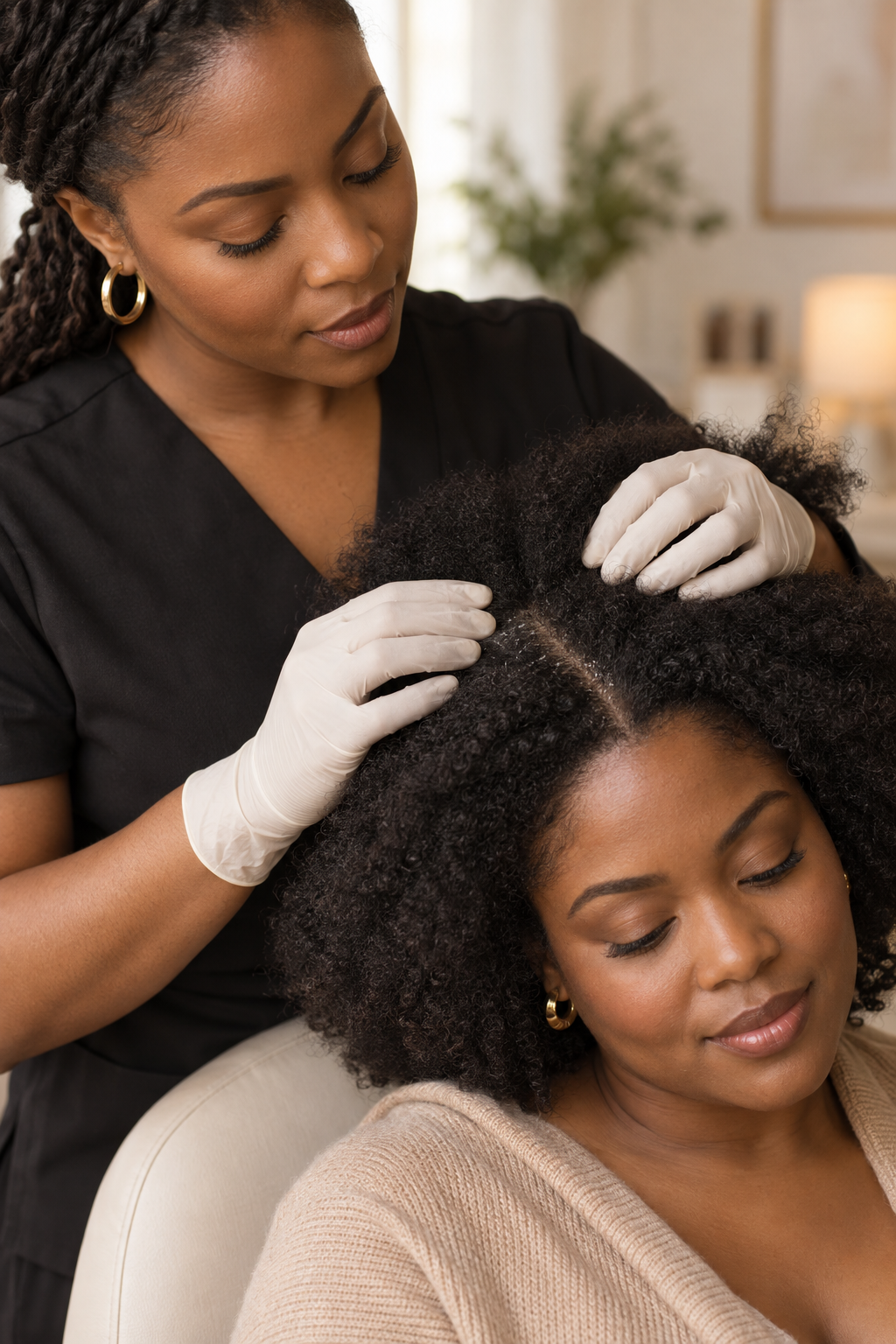
Flakes are a symptom—not a measure of cleanliness.
Flakes are not a moral failing or proof of poor hygiene. Understanding the skin activity beneath them leads to gentler care, better product use, and timely referral when symptoms persist.
You part your hair, notice the flakes, and reach for something to get them off—a comb, a scalp brush, or another shampoo. Maybe you have even apologized before sitting in a stylist's chair because you were embarrassed about what they might see.
You do not owe anyone an apology for having dandruff.
For too long, flakes have been treated like a cleanliness problem. Dandruff is not caused by poor hygiene, even though going longer between washes can make it more noticeable. Understanding that distinction changes how you care for your scalp—and how you feel about it.
There Is More Happening Beneath Those Flakes
Your scalp is skin. When it flakes, the question should extend beyond how to remove what you can see to why the skin is shedding that way.
A 2026 study in Immunity, Inflammation and Disease examined scalp tissue from people with dandruff and healthy volunteers. Researchers found increased proliferation of keratinocytes—the cells that form much of the skin's outer layer—and changes in how those cells mature. They also found higher proportions of immune cells producing IL-17, a chemical messenger involved in immune responses.
In everyday language, the dandruff-affected skin showed changes in both skin-cell activity and immune signaling. Researchers also identified changes in lipid mediators, fat-derived molecules that help regulate inflammation. Some have anti-inflammatory properties and may help explain why the inflammatory response remains subtle.
What About the Yeast Everyone Talks About?
You may have heard dandruff blamed on a yeast called Malassezia. That connection still belongs in the conversation.
Malassezia normally lives on human skin. Dandruff, generally considered the mildest form of seborrheic dermatitis, involves an interaction among yeast, scalp oils, and individual skin susceptibility. The presence of yeast alone does not mean your scalp is unhealthy or unclean.
The newer findings give us a fuller picture: what appears on the surface can reflect activity within the skin. Removing visible flakes is only one part of caring for that scalp.
Your Scalp Does Not Need to Be Scraped Clean
There is a reason scalp-scraping videos get attention. Watching a comb lift a patch of flakes can feel satisfying. But what looks satisfying on a screen is not a measure of whether the scalp is improving.
Scratching and irritation can aggravate seborrheic dermatitis. Dermatology guidance emphasizes gentle cleansing and avoiding products or habits that irritate the skin.
In the salon, that supports a careful approach: avoid digging with comb teeth, repeated scraping, and forceful scrubbing, especially when the scalp already feels sensitive. This is a practical application of irritation-minimizing care; the 2026 study did not directly test scraping or exfoliation.
That does not mean all scale removal is inappropriate. Salicylic acid, for example, is used in some dandruff shampoos. The distinction is between a treatment used according to directions and forcefully removing flakes simply to make the scalp look clear.
Build a Routine That Supports the Skin Beneath Your Hair
Consistent cleansing matters. The goal is to find an approach that addresses your scalp while respecting your hair's needs.
If regular shampoo is not controlling dandruff, a dandruff shampoo containing an active ingredient such as ketoconazole, selenium sulfide, or zinc pyrithione may help. Follow the label, including the recommended frequency and contact time. Rinsing too soon may mean you are not using the product as intended.
For curly and coily hair, focus dandruff shampoo on the scalp and condition the lengths as needed. Your scalp-care routine and your hair-care routine can work together. Persistent or severe symptoms should be assessed by a dermatologist.
For anyone wearing braids, twists, or locs, scalp access is a useful part of planning a routine. Consider how you will cleanse and apply any recommended treatment between appointments. A style should leave room for the care your scalp needs.
- Cleanse consistently enough to support your scalp
- Use medicated shampoo exactly as its label directs
- Focus treatment on the scalp and condition the hair lengths as needed
- Plan protective styles with cleansing and treatment access in mind
Know When Flakes Need Medical Attention
Not every flaky scalp has dandruff. Contact dermatitis, psoriasis, and fungal infections can also cause scaling.
Seek medical advice if your scalp is very itchy, red, or swollen, or if dandruff shampoo has not helped after about a month. Flaking accompanied by patchy hair loss also deserves evaluation.
A salon scalp camera can make surface changes easier to see and document. It cannot confirm the medical cause of those changes or detect the immune activity described in the research.
Thoughtful scalp care includes recognizing when a dermatologist needs to be part of the plan.
- Very itchy, red, painful, or swollen skin
- Flakes that persist after about a month of appropriate dandruff-shampoo use
- Patchy hair loss or another meaningful change in density
- Uncertainty about whether the scaling is actually dandruff
Your Crown Deserves Care Without Judgment
At Treasuring Tresses, a conversation about flakes begins with listening. What are you noticing? How does your scalp feel? What are you using, and what happens between wash days?
Those details help guide supportive salon care and identify when a medical referral is needed. There is no shame in needing help understanding your scalp.
Flakes are a symptom. They deserve attention, patience, and a plan that considers the skin beneath them.
Sources and Further Reading
This lesson draws on tissue-level dandruff research and public guidance from dermatology and health organizations. The research finding and practical-care guidance should be understood within their different scopes.
- Immunity, Inflammation and Disease (2026), doi: 10.1002/iid3.70467 — scalp-tissue study of dandruff and healthy volunteers
- NHS — Dandruff: causes, self-care, and when to seek medical advice
- DermNet — Seborrhoeic dermatitis: Malassezia, sebum, and individual susceptibility
- American Academy of Dermatology — Seborrheic dermatitis self-care and dandruff treatment guidance
Care for the Skin, Not Just the Flakes
Dandruff should not be treated as evidence that someone is dirty. The visible flakes can reflect a quiet interaction among skin-cell turnover, immune activity, scalp oils, yeast, and individual susceptibility.
Look closer without judgment.
Book a scalp consultation with Treasuring Tresses to document what you are noticing, discuss supportive salon care, and identify when a dermatology referral may be appropriate.
Book a Scalp Consultation