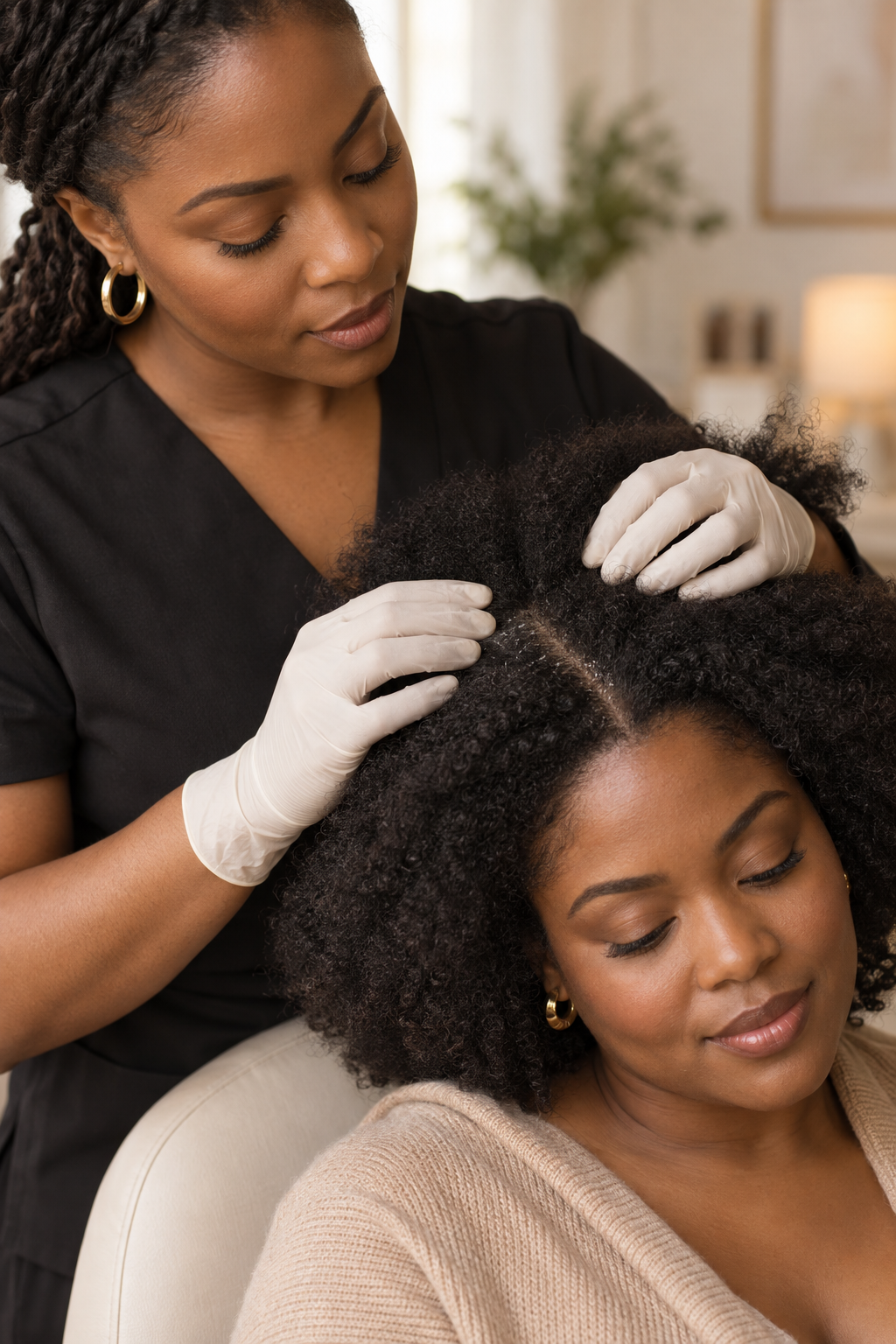
Stress may be one piece of the puzzle.
The connection between stress, your immune system, and your hair follicles—and why stress shedding is a different conversation.
We've all heard someone say it. "My hair started falling out because I've been stressed."
Maybe you've said it yourself. And depending on what's happening in your body, there may actually be some truth to it. Stress can affect us in ways we don't always recognize. It can disrupt our sleep, change our eating habits, affect our hormones, and influence how our immune system functions. And yes, it can affect our hair.
But here's where I want us to be careful. Not all hair loss associated with stress is the same, and stress isn't necessarily the reason your hair is falling out. There's a difference between excessive shedding caused by a stressful event and an autoimmune condition that causes the immune system to attack the hair follicle.
New research published in Nature on September 30, 2026, is helping scientists better understand that distinction. More importantly, it's revealing how the nervous system, immune system, and hair follicles communicate with one another. And the findings are worth talking about.
First, Let's Talk About Alopecia Areata
Before we get into the research, we need to understand what autoimmune hair loss actually is. Alopecia areata is an autoimmune disease in which the immune system mistakenly attacks hair follicles. Normally, our immune system protects us from things that could cause harm, such as infections. But with autoimmune conditions, that same protective system mistakenly targets healthy parts of the body. In alopecia areata, the hair follicle becomes one of those targets.
This can result in sudden hair loss, commonly appearing as smooth, round or oval patches on the scalp. However, alopecia areata doesn't always look the same on everyone. Some individuals experience loss of their eyebrows or eyelashes. Others may notice more widespread thinning, unusual changes to their nails, or sensations such as itching, tingling, or burning.
One encouraging thing about alopecia areata is that the immune attack often doesn't permanently destroy the follicle. That means hair regrowth is possible, although the condition can be unpredictable and some individuals experience recurring episodes or more extensive hair loss.
But here's the question researchers have been trying to answer: What causes the immune system to start attacking a hair follicle that it previously left alone? That's where this new research gets interesting.
The Discovery: Researchers Identified a Two-Hit Mechanism
A study published in Nature, titled A Two-Hit Mechanism Triggers Autoimmune Hair Loss, investigated how immune regulation and nervous-system activity may work together to initiate autoimmune hair loss. This was an experimental model of autoimmune alopecia in mice, not a clinical trial establishing how alopecia areata begins in humans.
Researchers identified two biological events that, when combined, created conditions that allowed the immune system to attack hair follicles. Let's break that down without turning this into a medical-school lecture.
Hit #1: The Immune System's Protective Balance Is Disrupted
Our immune system contains specialized cells called regulatory T cells, often shortened to T-reg cells. Think of these cells as the peacekeepers of the immune system. Their job is to help prevent unnecessary immune attacks against healthy tissue. Hair follicles also have a special protective feature known as immune privilege. Certain parts of the follicle are normally shielded from aggressive immune activity.
During the research, scientists temporarily reduced regulatory T-cell protection. But here's what was interesting. Disrupting that protection alone didn't automatically produce the same hair-loss response under every condition. Something else was involved.
Hit #2: The Nervous System Changes the Follicle's Environment
The second part of the discovery involved the sympathetic nervous system. This is the part of our nervous system associated with our fight-or-flight response. When we experience stress, our sympathetic nervous system can become more active.
Researchers found that sympathetic nerve activity surrounding hair follicles was naturally higher during the anagen phase, which is the active growth stage of the hair cycle. That activity released a chemical messenger called noradrenaline. Now, noradrenaline isn't automatically harmful. It's part of normal nervous-system communication.
However, researchers discovered that its signaling could affect hair-follicle stem cells in ways that made them more vulnerable to immune attack when regulatory immune protection was already compromised. The study also identified additional activity involving endogenous retroviral sequences and immune signaling inside the follicle, helping explain how that vulnerability could develop.
In simpler terms: When the immune system's protective balance was disrupted, certain types of nerve activity helped create an environment where autoimmune hair loss could begin. And then researchers introduced another factor. Psychological stress.
Stress may be one piece of the puzzle, but it is not necessarily the entire picture.
So, Can Stress Actually Trigger Alopecia Areata?
This is where we need to separate what the science discovered from what social media might turn it into. In experimental mouse models, researchers found that psychological stress increased sympathetic nervous-system activity. When that activity occurred alongside reduced immune regulation, hair follicles that had previously been resistant to autoimmune attack became more susceptible.
Now, before somebody runs to TikTok saying scientists have proven that stress causes alopecia, let's clear something up. That's not what the study proved. The research does not establish that stress alone causes alopecia areata in humans. What it suggests is that stress-related nervous-system activity may contribute to autoimmune hair loss when other biological conditions are already present.
The findings are significant, but they're also early. Much of the research involved controlled experimental models, and scientists still need to determine how directly these mechanisms translate to people living with alopecia areata. According to the American Academy of Dermatology, some individuals remember experiencing intense emotional stress or a major life event before developing alopecia areata. However, stress is not considered the underlying cause of the condition. Genetics, immune regulation, and other biological factors all play important roles.
So while stress may be one piece of the puzzle, it isn't necessarily the entire picture. And I think that's an important conversation to have. Because telling someone who has an autoimmune condition to simply relax, stop worrying, or get their stress under control overlooks what's actually happening inside their body.
But Stress Can Cause Another Type of Hair Loss
Now, let's talk about something I see come up frequently in hair-loss conversations. Telogen effluvium. Unlike alopecia areata, telogen effluvium is generally a form of excessive hair shedding triggered by a disruption in the normal hair-growth cycle.
Your hair naturally moves through different stages of growth, transition, rest, and shedding. When your body experiences a significant stressor, more hairs than usual may shift into the resting phase. Eventually, those hairs shed.
What's interesting is that the shedding doesn't always happen immediately. You might experience a major stressful event in January and not notice increased shedding until March or April. By then, you may not even connect the hair loss to what happened months earlier.
Some common triggers include:
- Significant emotional or psychological stress
- Major illness or high fever
- Surgery or physical trauma
- Childbirth and postpartum hormonal changes
- Rapid or substantial weight loss
- Nutritional deficiencies or inadequate food intake
- Certain medications or other physiological changes
In many cases, telogen effluvium improves once the underlying trigger has resolved and the body has had an opportunity to recover. However, prolonged stress or unresolved medical or nutritional concerns can contribute to continued shedding. This is why understanding what was happening in your life two or three months before noticing hair loss can sometimes be just as important as examining the scalp itself.
How Can You Tell the Difference Between Stress Shedding and Autoimmune Hair Loss?
Although both conditions involve hair loss, they often present differently.
Telogen Effluvium: More Hair Coming Out Than Usual
With telogen effluvium, shedding is commonly spread throughout the scalp rather than concentrated in one particular area. You may notice more hair than usual during shampooing, detangling, styling, or even when running your fingers through your hair. Your ponytail might feel smaller, or your overall density may appear reduced.
For individuals who wear braids, twists, locs, or other protective styles, accumulated naturally shed hair can make the situation seem even more alarming during a takedown. That's why we have to distinguish normal accumulated shedding from a significant increase in hair loss.
Alopecia Areata: Distinct Areas of Hair Loss
Alopecia areata more commonly presents with sudden, smooth patches of hair loss. These areas may appear without significant scaling or visible inflammation. Some individuals may also experience changes to their eyebrows, eyelashes, or nails. However, not every case presents with perfectly round patches. Diffuse forms of alopecia areata can create more widespread thinning, making professional evaluation even more important.
And here's something else worth remembering: a person can have more than one type of hair loss occurring at the same time. Someone can experience telogen effluvium while also having androgenetic alopecia, traction alopecia, or another scalp disorder. That's why a single symptom or photograph is rarely enough to explain the entire situation.
Why I Don't Believe in Calling Every Hair-Loss Concern "Just Stress"
One thing I consistently emphasize when discussing hair loss is the importance of understanding the cause before jumping into treatments. Because everything isn't stress. Everything isn't genetics. And everything isn't a vitamin deficiency. Sometimes we're dealing with inflammation. Sometimes it's hormonal. Sometimes it's repeated tension from styling practices. Sometimes the immune system is involved. And sometimes several things are happening together.
When evaluating hair and scalp concerns, I want to know more than simply how much hair someone is losing. I want to understand when it started. Was there a major illness or stressful event a few months ago? Has there been a change in medication, eating habits, or body weight?
Is the hair shedding from the root, or are the strands breaking along the shaft? Are we seeing smooth patches, overall thinning, or changes concentrated around the hairline or crown? Is there tenderness, itching, burning, or visible irritation? These are all important details.
And while professional scalp analysis and magnification can help us observe hair density, scalp conditions, and visible changes, a scalp camera cannot diagnose an autoimmune condition or determine the internal cause of hair loss. Certain concerns require evaluation by a dermatologist, who may recommend additional testing depending on the findings.
My role as a licensed cosmetologist and developing trichology professional is to recognize concerning patterns, educate clients, provide appropriate scalp care, and encourage medical evaluation when necessary. Because sometimes the most valuable service I can provide isn't a treatment. It's helping someone recognize that their concern deserves further investigation.
Where Does Head Spa and Scalp Wellness Fit Into All of This?
Now, let's talk about something that matters to me as both a cosmetologist and the owner of Treasuring Tresses Collective. The connection between scalp wellness and overall well-being. We know stress can affect the body in numerous ways. And while we cannot eliminate every stressful circumstance from our lives, we can develop habits that support better physical and emotional wellness. Adequate sleep, balanced nutrition, movement, rest, and healthy stress-management practices all contribute to our general well-being.
A head spa experience can complement those practices by providing an opportunity to slow down, relax, and receive intentional care. Scalp massage may help relieve feelings of tension and promote relaxation. Appropriate cleansing can help maintain scalp hygiene, while a personalized hair-care routine can minimize unnecessary irritation and mechanical stress.
But let's be very clear. A head spa is not a treatment for autoimmune alopecia. No amount of scalp massage, steaming, exfoliation, essential oils, or relaxation can be promised to stop an autoimmune attack on the hair follicle. And honestly, I think we do ourselves and our clients a disservice when we make those kinds of claims.
Luxury scalp care and responsible hair-loss education can absolutely coexist. In fact, they should. There's value in creating an environment where someone can relax, feel cared for, and learn more about their scalp without being promised results that aren't scientifically supported. There's also value in knowing when the appropriate next step is a dermatologist rather than another salon treatment. Self-care is stewardship, but stewardship also means knowing when to seek the right help.
When Should You Seek Professional Help for Hair Loss?
If you're noticing sudden or unexplained hair loss, don't automatically assume stress is the cause. Consider scheduling an evaluation with a dermatologist, particularly if you're experiencing:
- Sudden, smooth patches of hair loss
- Persistent or progressively worsening shedding
- Loss of eyebrows or eyelashes
- Changes to your nails alongside hair loss
- Significant scalp discomfort, burning, tenderness, or inflammation
- Progressive thinning without an identifiable explanation
Early evaluation matters, especially because certain forms of hair loss can lead to permanent follicular damage if left untreated. Alopecia areata itself is typically nonscarring, but other conditions, including scarring alopecias, require timely medical attention. The sooner the underlying concern is identified, the sooner an appropriate care plan can be developed.
References & Further Reading
The research findings describe experimental biology; the patient guidance helps put hair-loss patterns into context.
- Cui J, Wu P, Chang Y, et al. A two-hit mechanism triggers autoimmune hair loss. Nature (2026).: https://www.nature.com/articles/s41586-026-11098-y
- Minton K. Sympathetic nerve activity primes susceptibility to autoimmune hair loss. Nature Reviews Immunology (2026).: https://www.nature.com/articles/s41577-026-01365-4
- American Academy of Dermatology: Alopecia areata causes: https://www.aad.org/public/diseases/hair-loss/types/alopecia/causes
- American Academy of Dermatology: Hair loss or hair shedding?: https://www.aad.org/public/diseases/hair-loss/insider/shedding/
- American Academy of Dermatology: Skin and hair conditions linked to stress: https://www.aad.org/public/diseases/a-z/stress-skin-conditions
Self-Care Is Stewardship
Self-care is stewardship, but stewardship also means knowing when to seek the right help. Luxury scalp care and responsible hair-loss education can coexist without promises that are not scientifically supported.
Your Crown Is Giving You Clues
Our follicles respond to signals from the nervous system, immune system, hormones, nutrition, and overall health. Emerging research helps explain possible connections; it does not make stress the explanation for every hair-loss concern.
Not every shedding concern needs a growth serum. Sometimes we need to ask better questions, pay attention to the pattern, and look beyond the surface. Understanding why you’re losing hair is just as important as figuring out how to care for what’s growing.
Ask Better Questions About Your Crown
Keep learning in the Journal, and take sudden or unexplained hair loss to a dermatologist.
Explore the Journal